A rewards program for the truck — costing about half what the daily discount sign costs you now, and paying out only to people who keep coming back.
Everything in here was built from the outside — your menu board, your prices, the sign on the sidewalk and one conversation at the window. It is a serious proposal, but it is a first draft against real numbers I have not seen yet.
Once I have your sales history, parts of this will change. Maybe the card is 8 stamps instead of 10. Maybe the reward is a bowl, not a smoothie, because bowls are what people actually come back for. Maybe the menu items I have flagged turn out to be your best sellers and should be protected rather than cut. The data decides that, not me.
That is the point of showing you the thinking now. I would rather you see how the decisions get made and push back on them, than hand you a polished plan built on guesses and call it strategy.
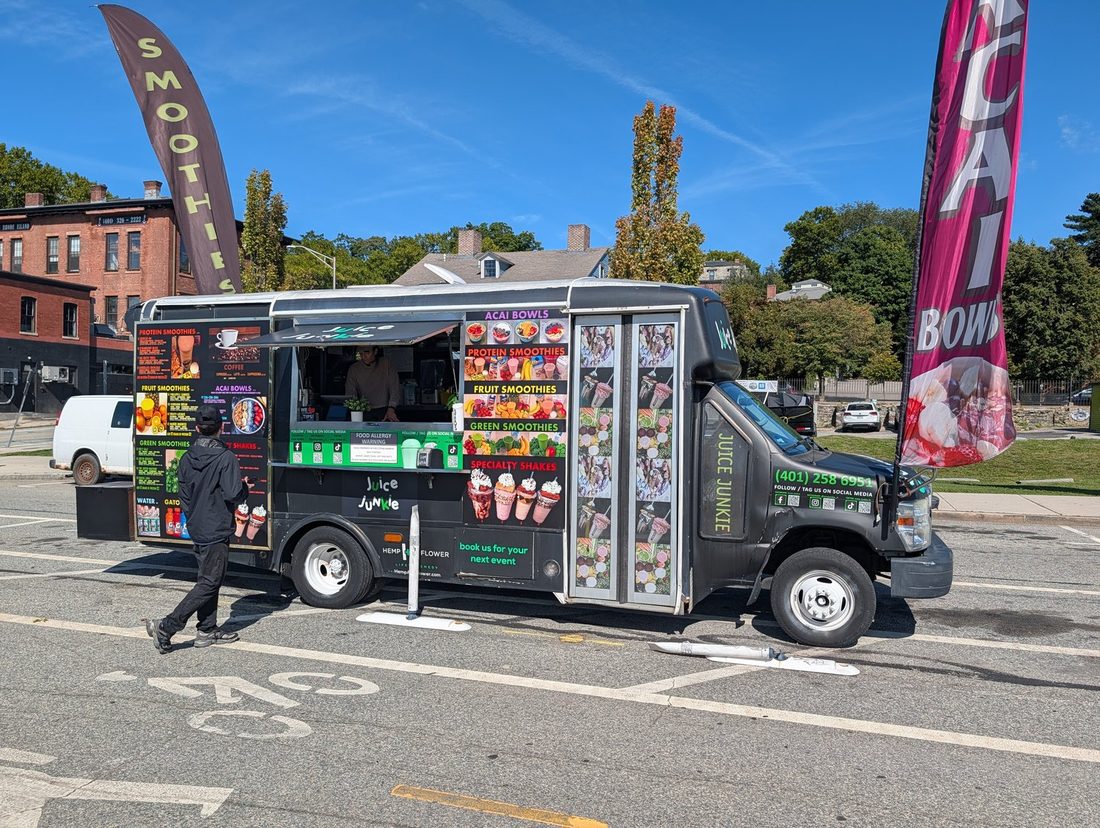
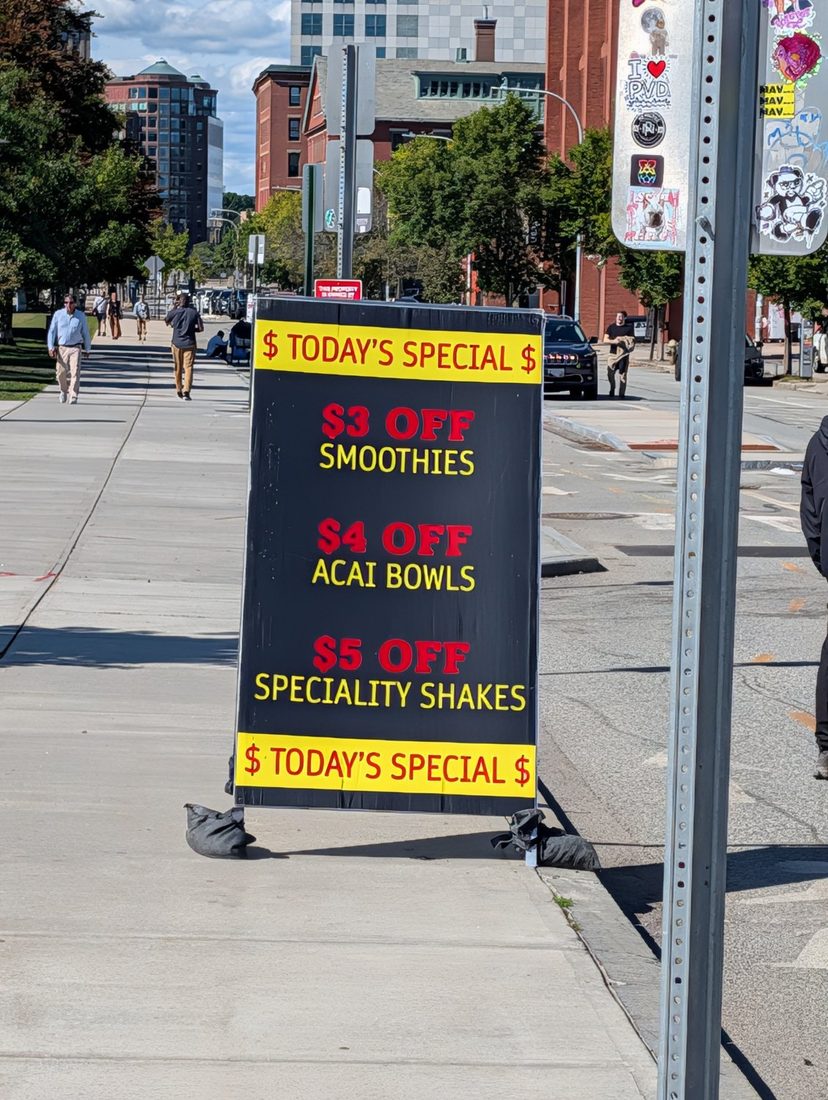
I stopped by the truck at the pedestrian bridge. The food is priced like a premium product — $12 to $20 — and the branding backs it up. Then there is a sandwich board on the sidewalk taking $3 to $5 back off, every single day.
| Item | Menu price | Sign | You give up |
|---|---|---|---|
| Fruit smoothie | $12 | $3 off | 25.0% |
| Green smoothie | $13 | $3 off | 23.1% |
| Protein smoothie | $14 | $3 off | 21.4% |
| Acai bowl | $17 | $4 off | 23.5% |
| Specialty shake | $20 | $5 off | 25.0% |
| Average given away on every sale | 23.6% | ||
Here is the part that stings: that discount goes to everyone. The regular who would have paid $14 anyway. The tourist walking the bridge once this year who will never come back. There is no way to tell them apart, so you pay both.
Same menu, same generosity in the customer's eyes, roughly half the cost, and every dollar of it buys a return visit instead of a one-off.
Rewards programs are not a gimmick or a nice gesture. They are the most heavily measured retention tool in food service, and the companies with the best data on earth spend the most money on them. That is worth two minutes before deciding whether it fits a smoothie truck.
The obvious objection: those are billion-dollar companies with app teams. Fair. So here are the numbers from independent shops running the same idea with a stamp card:
This is not a food thing. The car wash down the road, the nail salon, the gym, Sephora, the sandwich shop — they all run the same play, because the behaviour it triggers is not about the product. It is about having something unfinished.
Researchers handed car wash customers one of two loyalty cards. One needed 8 stamps for a free wash. The other needed 10 — but arrived with 2 already stamped. Identical work either way: eight visits.
Nearly double the completion rate, from a card that asked for exactly the same number of visits. And they came back faster — every 12.7 days instead of 14.6.
That is the whole idea in one experiment. A discount makes today cheaper and then it is over. An unfinished card follows someone around.
There is a specific way to set a card up that takes advantage of this. It costs nothing to do and most programs get it wrong. It is one of maybe a dozen decisions like it — the reward, the threshold, the wording, the timing — that separate a card people finish from a card that ends up in a drawer.
85% of quick-service customers say the thing that matters most in a rewards program is saving money — not badges, tiers or early access. So the reward has to be something real: a free smoothie, not a token. The difference is that the cost only lands after somebody has already come back seven times, instead of on every stranger who walks past the sign.
Sources: Starbucks Rewards member revenue share · Chipotle Rewards membership · MyPanera relaunch 2026 · Independent coffee shop loyalty data · Nunes & Drèze car wash study · Alchemer QSR study 2026 · Paytronix loyalty ROI
A regular coffee shop does not really need this. It is on the same corner every morning, so people walk past it by accident. You do not have that. You are at the pedestrian bridge some days and outside a gym other days, and a customer who loved their smoothie last week has no idea where you are today.
Right now, a repeat visit depends on somebody happening to walk past the truck again. That is luck, not a business.
Every person who joins can get a message: "We're outside LA Fitness till 2pm." That turns a parked truck into a destination.
Followers belong to Instagram. A rewards list belongs to you, and it still works when the algorithm stops showing your posts.
For a fixed shop, a rewards program is a nice-to-have. For a truck that moves, it is the only thing that reliably tells your best customers where to find you tomorrow. Every other benefit below is a bonus on top of that one.
And we will tell you where the truck is parked.
Getting close. Next one is on us.
Show it at the window. Card resets after.
This is the half nobody pitches you, and it is worth more than the free smoothies. Every stamp is a data point about who buys what, where, and when.
Stop parking at the bottom one. That decision alone can pay for the program.
20 numbered items is a lot to read in a queue. The data tells you which ones to cut.
The truck says "franchise options" on the back. Nobody buys a franchise on vibes — they buy proven unit economics. Repeat-customer rates, revenue per location per hour and a named customer list are exactly the numbers a buyer asks for. Twelve months of this data is worth more at the negotiating table than another good summer.
I spent an afternoon at the truck with a camera and a notepad. No sales data, no access to anything. Here is what turned up anyway — and it is a fraction of what shows up once the numbers are on the table.
Because the detail is the work. Anybody can tell you "do a loyalty program" — the value is in knowing which reward, at which threshold, sent at which minute, to which half of your customer list, and which three items to stop buying. That is what you would be hiring me for, and it is built on your numbers, not on a template.
Same spot on the sidewalk, same eye-catching job — but instead of handing a stranger 23% off, it collects a customer you can reach again.

If the owner wants to keep a discount running, keep it — but make it members only. Then the $3 off still pulls people in, and it buys a phone number and a reason to come back instead of nothing.
Smoothies in February are a hard sell. That is exactly why the work should happen in October — so the list is already built when you need it.
Every person who walks up in October is someone you can reach in January. Put the sign-up board out now and the autumn crowd becomes your winter customer list. Waiting until sales dip means building a list with nobody standing in front of the truck.
The coffee is already on the board and nearly invisible. A small hot section — coffee, a hot chocolate protein shake, an immunity shot — gives people a reason to stop in the cold, and it still earns a stamp.
On a dead cold Tuesday, do not drop $3 off. Send "double stamps today" to the list. It pulls the same traffic and costs you nothing until somebody has already come back several times.
A few hundred named customers you can text the day the weather turns, instead of waiting to be rediscovered.
There are apps you can sign up for yourself. What there is not, is somebody who sets the thing up around your menu, writes the messages, watches the numbers and tells you when to change course. That is the job. Here is everything in it.
Some of this you could stitch together yourself with a $45 a month app and a few weekends. The part you cannot buy off a shelf is somebody looking at your actual numbers and deciding what the program should be — then changing it when the numbers change. The software is the cheap part. The decisions are the job.
I build marketing systems for small businesses here, not for chains and not from three time zones away. I can stand at the pedestrian bridge at 11:30 on a Tuesday and watch who walks past, because it is fifteen minutes from me.
The software for this is cheap and well established. The real cost is the free smoothies, and those only happen after seven paid ones.
| Item | Typical cost |
|---|---|
| The software underneath it Wallet card, QR sign-up, message sending | $20–50 / mo |
| Text messages Priced per message, scales with your list | Cents each |
| New A-frame sign panel | One-off, ~$60–120 |
| Reward cost | 12.5% and only on visit 8 |
| Versus the sign you run today | 23.6% of everything |
Put plainly: the monthly software costs roughly what three discounted smoothies cost you. If the program brings back even a handful of customers who would otherwise have drifted, it has paid for itself several times over.
The local discount runs for twelve months on a signed agreement. I am telling you up front that it is a first-year rate rather than burying it, because finding that out on month thirteen's invoice is how people stop trusting you.
The 30% applies to the setup and to your first twelve months, on a signed twelve-month agreement. After that it moves to the standard $300 a month. No price rise in month four, no auto-renewal you have to catch — we talk before year two and you decide then, with a year of your own numbers in front of you.
If by then it has not earned far more than $300 a month, you should not renew it, and I will say so myself.
The monthly works out to the discount you currently give away on about seventy smoothies. If the program stops seventy $3 give-aways a month — roughly two a day — it has paid for itself before a single extra customer walks up.
Everything after that — the repeat visits, the bigger orders, the customers you can text on a dead February Tuesday — is the part you are actually buying.
The twelve-month term is what the discount is attached to, but the shape of it is open. If the setup is easier to carry spread over the first few months, say so. If you would rather run a shorter trial period first and sign the year once you have seen real numbers, ask — I will not be difficult about it. I am trying to build something that works for a business with a slow season, not lock you into something that stops making sense in January.
Everything above is a first draft. It only becomes a plan once it is built on your actual numbers rather than my assumptions — so before anything gets set up, I need:
From there I set up the card, design the new sign panel, write the sign-up flow and the first month of messages, and train whoever is at the window — it takes about two minutes to learn.
If the numbers say a rewards program is the right move, we start at $1,050 to build it and $210 a month to run it for your first year, on a twelve-month agreement, then $300 after that. Terms are flexible — if spreading the setup or running a shorter trial first makes it easier to say yes, tell me and we will work it out.
If the data shows a rewards program will not move the needle for you, I will say so. I would rather tell you that than sell you a subscription.