Juice Junkie Providence, RI Prepared for the owner

You are already giving away
23% of every sale.
Let's make it buy something.

A rewards program for the truck — costing about half what the daily discount sign costs you now, and paying out only to people who keep coming back.

Prepared byProject5pi
ForJuice Junkie · (401) 258-6951
DateSeptember 2026
Read timeAbout 6 minutes
Read this first

This is a starting point, not a finished plan

Everything in here was built from the outside — your menu board, your prices, the sign on the sidewalk and one conversation at the window. It is a serious proposal, but it is a first draft against real numbers I have not seen yet.

Once I have your sales history, parts of this will change. Maybe the card is 8 stamps instead of 10. Maybe the reward is a bowl, not a smoothie, because bowls are what people actually come back for. Maybe the menu items I have flagged turn out to be your best sellers and should be protected rather than cut. The data decides that, not me.

That is the point of showing you the thinking now. I would rather you see how the decisions get made and push back on them, than hand you a polished plan built on guesses and call it strategy.

What I saw at the truck

The sign on the sidewalk is the problem and the opportunity

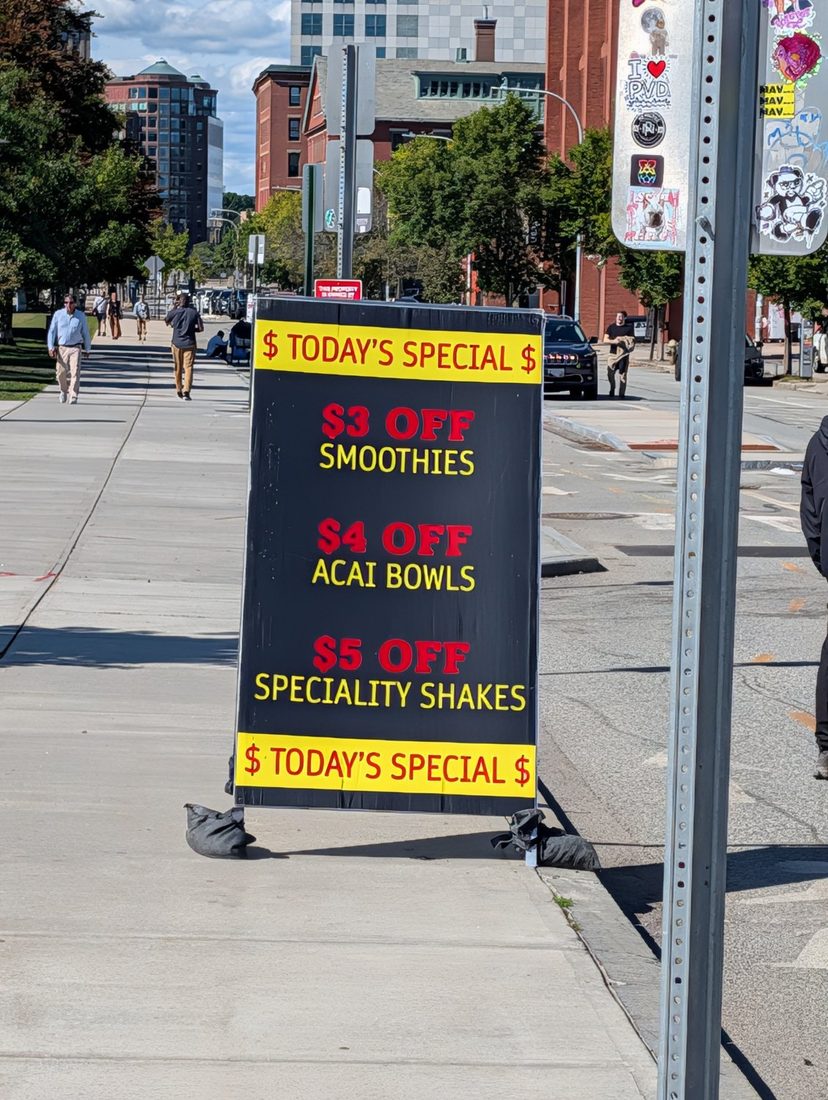
I stopped by the truck at the pedestrian bridge. The food is priced like a premium product — $12 to $20 — and the branding backs it up. Then there is a sandwich board on the sidewalk taking $3 to $5 back off, every single day.

Today's Special A-frame sign: $3 off smoothies, $4 off acai bowls, $5 off specialty shakes
The current sidewalk sign. If this is out every day, it is not a special — it is the price.
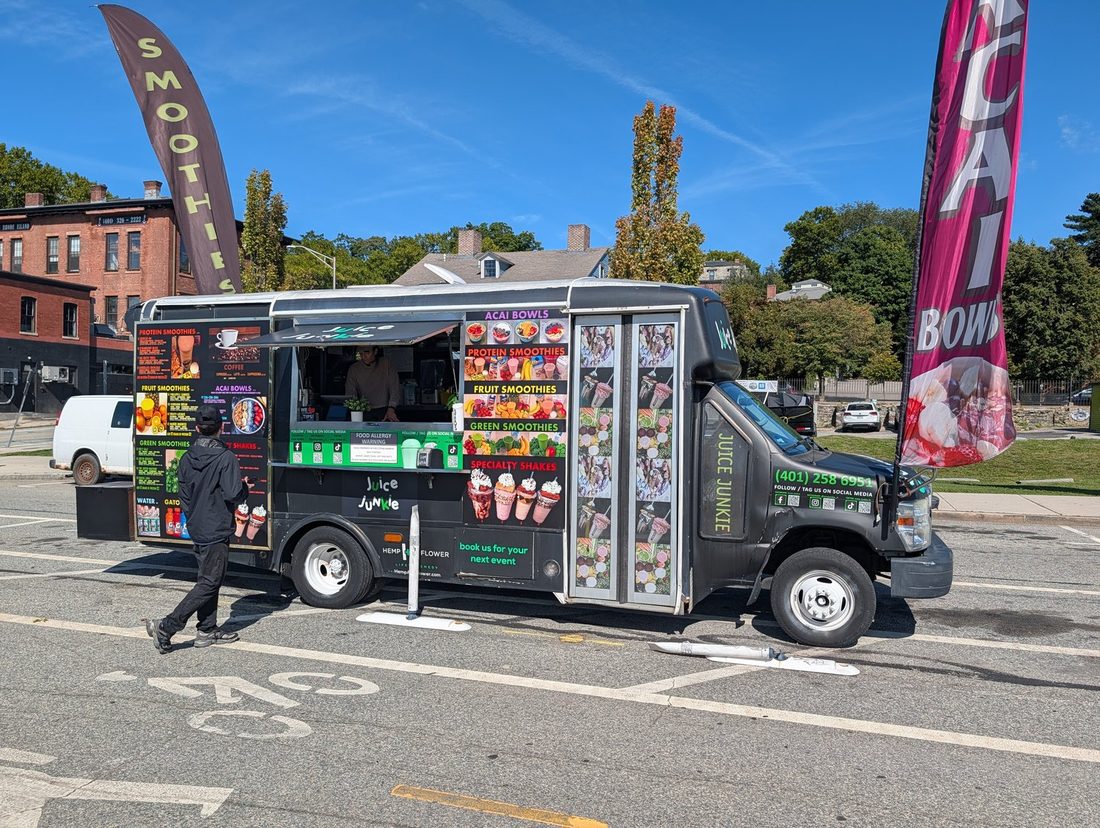
Juice Junkie truck parked near the pedestrian bridge in Providence
The truck does its job: people can see what you sell from across the lot.

What that sign actually costs

ItemMenu priceSignYou give up
Fruit smoothie$12$3 off25.0%
Green smoothie$13$3 off23.1%
Protein smoothie$14$3 off21.4%
Acai bowl$17$4 off23.5%
Specialty shake$20$5 off25.0%
Average given away on every sale23.6%

Here is the part that stings: that discount goes to everyone. The regular who would have paid $14 anyway. The tourist walking the bridge once this year who will never come back. There is no way to tell them apart, so you pay both.

23.6% → 12.5%
A "buy 7, get the 8th free" card on the same menu costs 12.5% — about half — and only pays out after somebody has come back seven times.

Same menu, same generosity in the customer's eyes, roughly half the cost, and every dollar of it buys a return visit instead of a one-off.

Why this works at all

Every chain you can name runs one of these. They are not being sentimental.

Rewards programs are not a gimmick or a nice gesture. They are the most heavily measured retention tool in food service, and the companies with the best data on earth spend the most money on them. That is worth two minutes before deciding whether it fits a smoothie truck.

60%
of Starbucks US company-operated revenue comes from Rewards members
35.5M active members · $13B+ in member spend
21M
active members in Chipotle Rewards
Rebuilt and relaunched rather than dropped
70M
people enrolled in MyPanera
Overhauled again in 2026 — they keep investing

The obvious objection: those are billion-dollar companies with app teams. Fair. So here are the numbers from independent shops running the same idea with a stamp card:

22%more often loyalty members visit, compared with non-members
20–30%higher customer retention at coffee shops running an active program
5.6×more likely a member becomes a daily regular

It is the same mechanism in every industry that uses it

This is not a food thing. The car wash down the road, the nail salon, the gym, Sephora, the sandwich shop — they all run the same play, because the behaviour it triggers is not about the product. It is about having something unfinished.

Coffee & QSR
Stamp cards and points. Turns an occasional stop into a routine one.
Car washes
Where the research below was actually done. Punch cards, measured properly.
Salons & gyms
Visit-based rewards, because the whole business is frequency.
Retail & beauty
Tiers and points. Members out-spend walk-ins by a wide margin.

The study that explains why a card beats a discount

Researchers handed car wash customers one of two loyalty cards. One needed 8 stamps for a free wash. The other needed 10 — but arrived with 2 already stamped. Identical work either way: eight visits.

19%
finished the card that started empty
vs
34%
finished the card that started with 2 stamps

Nearly double the completion rate, from a card that asked for exactly the same number of visits. And they came back faster — every 12.7 days instead of 14.6.

That is the whole idea in one experiment. A discount makes today cheaper and then it is over. An unfinished card follows someone around.

There is a specific way to set a card up that takes advantage of this. It costs nothing to do and most programs get it wrong. It is one of maybe a dozen decisions like it — the reward, the threshold, the wording, the timing — that separate a card people finish from a card that ends up in a drawer.

And what people actually want from it

85% of quick-service customers say the thing that matters most in a rewards program is saving money — not badges, tiers or early access. So the reward has to be something real: a free smoothie, not a token. The difference is that the cost only lands after somebody has already come back seven times, instead of on every stranger who walks past the sign.

Sources: Starbucks Rewards member revenue share · Chipotle Rewards membership · MyPanera relaunch 2026 · Independent coffee shop loyalty data · Nunes & Drèze car wash study · Alchemer QSR study 2026 · Paytronix loyalty ROI
Why this matters more for a truck

A rewards list is the only way a mobile business gets found on purpose

A regular coffee shop does not really need this. It is on the same corner every morning, so people walk past it by accident. You do not have that. You are at the pedestrian bridge some days and outside a gym other days, and a customer who loved their smoothie last week has no idea where you are today.

The real problem

They can't find you

Right now, a repeat visit depends on somebody happening to walk past the truck again. That is luck, not a business.

What the list does

You tell them where you are

Every person who joins can get a message: "We're outside LA Fitness till 2pm." That turns a parked truck into a destination.

Why it compounds

The list is yours

Followers belong to Instagram. A rewards list belongs to you, and it still works when the algorithm stops showing your posts.

This is the strongest argument for doing it

For a fixed shop, a rewards program is a nice-to-have. For a truck that moves, it is the only thing that reliably tells your best customers where to find you tomorrow. Every other benefit below is a bonus on top of that one.

What the customer sees

Their side: four taps, no app store

9:41●●●
Join the habit
Free smoothie
when the card fills.

And we will tell you where the truck is parked.

Mobile number
First name
Join in 20 seconds
No app. No password.
1 · Scan & join
9:41●●●
Your card
6 of 10
7
8
9
FREE

Getting close. Next one is on us.

Show at the window
2 · Their card
11:02●●●
Where we are today
📍 Outside LA Fitness till 2pm
Come find us before the lunch rush.
🎂 Happy birthday, Marcus
Free upgrade on anything this month.
✨ You are 1 stamp away
Next one is free. We are at the bridge tomorrow 11–3.
See the truck schedule
3 · You reach them
13:20●●●
Reward unlocked
🍸
Your smoothie
is free.
Show this at the window
JJ-4417

Show it at the window. Card resets after.

Redeem
4 · Payday
Mockup — layout and wording for discussion, not a finished app
What the owner sees

Your side: the truck finally tells you what it knows

This is the half nobody pitches you, and it is worth more than the free smoothies. Every stamp is a data point about who buys what, where, and when.

Juice Junkie — last 30 days
SAMPLE DATA — SHAPE OF THE REPORT, NOT REAL NUMBERS
Members
412
Repeat visit rate
38%
Visits per member
2.7
Rewards redeemed
46

Which location actually pays

Pedestrian bridge — Sat$/hr
LA Fitness — Mon AM$/hr
Pedestrian bridge — Tue$/hr
Office park — Thu PM$/hr

Stop parking at the bottom one. That decision alone can pay for the program.

What sells, what just takes up the board

Protein smoothies
Acai bowls
Fruit smoothies
Specialty shakes
Coffee

20 numbered items is a lot to read in a queue. The data tells you which ones to cut.

What you would be able to answer, that you cannot today

The franchise angle

The truck says "franchise options" on the back. Nobody buys a franchise on vibes — they buy proven unit economics. Repeat-customer rates, revenue per location per hour and a named customer list are exactly the numbers a buyer asks for. Twelve months of this data is worth more at the negotiating table than another good summer.

What I found before you hired anybody

Three things about your business you almost certainly do not know

I spent an afternoon at the truck with a camera and a notepad. No sales data, no access to anything. Here is what turned up anyway — and it is a fraction of what shows up once the numbers are on the table.

01
Nine of your thirty-eight ingredients exist for a single drink
I transcribed all twenty items off your board and mapped every ingredient against every recipe. Most of your shopping list is shared across the menu, which is good. But nine ingredients are bought for exactly one item — and three of those go off. If those three drinks are slow sellers, you are paying to throw food away every week. I can tell you which three.
02
The obvious menu cut would have saved you nothing
Everybody's instinct is to drop the slowest seller. On your menu, the item most people would cut first shares its expensive ingredient with two other things on the board — so cutting it removes the sale and keeps the cost. The saving only appears when you cut the last item using an ingredient, and working out which one that is takes the map, not a hunch. That map exists. It took an afternoon.
03
There is a thirty-minute window on weekdays that decides your lunch rush
The crowd at the pedestrian bridge is not random and it does not decide at noon. There is a specific half hour before lunch when those offices choose where they are going, and almost nothing you do after it matters. Reaching them inside that window is worth more than any discount on a sandwich board. We would build the whole weekday campaign around it.

Why I am not spelling all of it out here

Because the detail is the work. Anybody can tell you "do a loyalty program" — the value is in knowing which reward, at which threshold, sent at which minute, to which half of your customer list, and which three items to stop buying. That is what you would be hiring me for, and it is built on your numbers, not on a template.

The sign

Replace the discount board with a sign-up board

Same spot on the sidewalk, same eye-catching job — but instead of handing a stranger 23% off, it collects a customer you can reach again.

Current discount sign
Now: gives away a quarter of the sale to whoever happens to be walking past.
FREE SMOOTHIE CLUB
Your next one
is on us.
Scan it once. We stamp it every visit.
No app, no password.
Scan to join
Scan → add number → done
Takes about twenty seconds
WE WILL TEXT YOU WHERE THE TRUCK IS
Proposed: same board, same frame. QR shown for layout — it points at the live sign-up page once the program is set up.

If the owner wants to keep a discount running, keep it — but make it members only. Then the $3 off still pulls people in, and it buys a phone number and a reason to come back instead of nothing.

Timing

Winter is the reason to do this now, not the reason to wait

Smoothies in February are a hard sell. That is exactly why the work should happen in October — so the list is already built when you need it.

October — while it is still busy

Build the list during the last warm weeks

Every person who walks up in October is someone you can reach in January. Put the sign-up board out now and the autumn crowd becomes your winter customer list. Waiting until sales dip means building a list with nobody standing in front of the truck.

November

Warm menu, same card

The coffee is already on the board and nearly invisible. A small hot section — coffee, a hot chocolate protein shake, an immunity shot — gives people a reason to stop in the cold, and it still earns a stamp.

December – February

Use stamps instead of cutting price

On a dead cold Tuesday, do not drop $3 off. Send "double stamps today" to the list. It pulls the same traffic and costs you nothing until somebody has already come back several times.

March

Come out of winter with something you did not have

A few hundred named customers you can text the day the weather turns, instead of waiting to be rediscovered.

What you would actually get

The whole system, built and run — not a subscription you have to figure out

There are apps you can sign up for yourself. What there is not, is somebody who sets the thing up around your menu, writes the messages, watches the numbers and tells you when to change course. That is the job. Here is everything in it.

For your customers
  • Digital stamp card that lives in Apple Wallet or Google Wallet — no app to download, no password to forget
  • QR sign-up page, built mobile-first — name and number, done in under twenty seconds standing at the window
  • Card and progress screen so they can see how close they are
  • Reward screen with a redemption code your staff can check in one glance
  • "Where is the truck" page — your schedule, always current
  • Automatic reminders: one stamp away, birthday, we-miss-you
For you, at the window
  • One-tap stamping on whatever phone or tablet is already in the truck
  • Built to survive bad signal — you are running off a generator in a car park, so it cannot fall over when the bars drop
  • Redemption check that takes a second and cannot be faked
  • Staff training — it takes about two minutes to learn, and I do it with whoever is serving
The texting system
  • Campaign setup and sending — the actual messages going out, on schedule, without you touching it
  • Audience segments by where somebody joined, what they buy and when they last came
  • Timed sends tied to where the truck is parked that day
  • Message writing — I write the copy, you approve it
  • Opt-in capture and STOP handling built in from day one
  • A monthly send calendar so it is planned, not improvised
Behind the scenes
  • Connecting to your POS so sales, items and times flow through without double entry
  • Member database that is yours — exportable, not locked to a platform
  • Owner dashboard: members, repeat rate, redemptions, revenue per location per hour
  • Duplicate and abuse checks so the card cannot be farmed
  • Backups and hosting, monitored, not left to chance
On the truck and the street
  • New sign-up board to replace the discount A-frame — designed and print-ready
  • QR decals for the window, the counter and the cups
  • A simple website — right now you have a phone number and social handles and nothing that turns up in a search. Menu, schedule, and a form for event bookings, since the truck already advertises them
The thinking, ongoing
  • Program design built on your sales history — reward, threshold and rules chosen from your numbers
  • Menu profitability analysis — what to keep, cut and protect, and why
  • Location analysis — which pitches earn per hour and which to drop
  • A winter plan for the slow months, written before they arrive
  • Monthly review — one page, plain English, what moved and what to do next

One thing worth saying plainly

Some of this you could stitch together yourself with a $45 a month app and a few weekends. The part you cannot buy off a shelf is somebody looking at your actual numbers and deciding what the program should be — then changing it when the numbers change. The software is the cheap part. The decisions are the job.

Who you would be working with

Rhode Island is small. That is the whole point.

I build marketing systems for small businesses here, not for chains and not from three time zones away. I can stand at the pedestrian bridge at 11:30 on a Tuesday and watch who walks past, because it is fifteen minutes from me.

Local means I can see it
This proposal exists because I stood at your truck, read your sign and photographed your menu. That is not something an agency in another state does for a smoothie truck.
You are up against chains
Every national brand near you runs a rewards program with a team behind it. The tools are not the advantage any more — they are cheap. Knowing how to point them at a Providence lunch crowd is.
I want the local ones to win
A truck that can survive a Rhode Island winter and franchise out of it is worth more to this state than another chain location. That is the kind of business I would rather spend my time on.
Honest numbers

What it costs to run

The software for this is cheap and well established. The real cost is the free smoothies, and those only happen after seven paid ones.

ItemTypical cost
The software underneath it
Wallet card, QR sign-up, message sending
$20–50 / mo
Text messages
Priced per message, scales with your list
Cents each
New A-frame sign panelOne-off, ~$60–120
Reward cost12.5% and only on visit 8
Versus the sign you run today23.6% of everything

Put plainly: the monthly software costs roughly what three discounted smoothies cost you. If the program brings back even a handful of customers who would otherwise have drifted, it has paid for itself several times over.

What I charge

Rhode Island small business rate — 30% off your first year

The local discount runs for twelve months on a signed agreement. I am telling you up front that it is a first-year rate rather than burying it, because finding that out on month thirteen's invoice is how people stop trusting you.

Build it
$1,500
$1,050
one-time setup · 30% off
Program designed around your sales data, the card and sign-up built, POS connected, sign and decals designed, website up, staff trained, first month of messages written. You are live and running before anything monthly starts.
Run it
$300
$210/mo
months 1–12 · 30% off
Campaigns written and sent, segments maintained, dashboard and reporting, the monthly review, and changes to the program as the numbers tell us to make them. The third-party software sits inside this — no separate bill to chase.
Local discount, year oneYou save $1,530
First twelve months, all in$3,570
The bit most proposals hide, said plainly

The 30% applies to the setup and to your first twelve months, on a signed twelve-month agreement. After that it moves to the standard $300 a month. No price rise in month four, no auto-renewal you have to catch — we talk before year two and you decide then, with a year of your own numbers in front of you.

If by then it has not earned far more than $300 a month, you should not renew it, and I will say so myself.

What that actually has to beat

The monthly works out to the discount you currently give away on about seventy smoothies. If the program stops seventy $3 give-aways a month — roughly two a day — it has paid for itself before a single extra customer walks up.

Everything after that — the repeat visits, the bigger orders, the customers you can text on a dead February Tuesday — is the part you are actually buying.

The terms are negotiable and I would rather talk than trade documents

The twelve-month term is what the discount is attached to, but the shape of it is open. If the setup is easier to carry spread over the first few months, say so. If you would rather run a shorter trial period first and sign the year once you have seen real numbers, ask — I will not be difficult about it. I am trying to build something that works for a business with a slow season, not lock you into something that stops making sense in January.

What happens next

Two things from you, then I build it

Everything above is a first draft. It only becomes a plan once it is built on your actual numbers rather than my assumptions — so before anything gets set up, I need:

  • Which POS you use at the window — Square, Toast, Clover or something else. That decides whether the program bolts onto what you have or runs alongside it.
  • A sales export, last 6 months — items, times, locations. No customer names needed. That tells us which of the seven orphan items actually sell, which pitches earn, and what the winter dip really looks like.

From there I set up the card, design the new sign panel, write the sign-up flow and the first month of messages, and train whoever is at the window — it takes about two minutes to learn.

If the numbers say a rewards program is the right move, we start at $1,050 to build it and $210 a month to run it for your first year, on a twelve-month agreement, then $300 after that. Terms are flexible — if spreading the setup or running a shorter trial first makes it easier to say yes, tell me and we will work it out.

If the data shows a rewards program will not move the needle for you, I will say so. I would rather tell you that than sell you a subscription.